 English
 Deutsch

Koenig & Bauer and Siemens Shape the Next-Generation Software-Defined Machine Architecture
Modular software modules and open IT structures ensure maximum flexibility and investment security in high-performance mechanical engineering
- Structured transition to a consistent, object-oriented IT infrastructure in high-performance mechanical engineering
- Translation of complex machine functions into modular software components
- Open architecture as a strategic response to the global shortage of skilled workers
- Concept is being tested directly on the prototype
- Multi-year roadmap steers towards the drupa 2028 industry trade fair
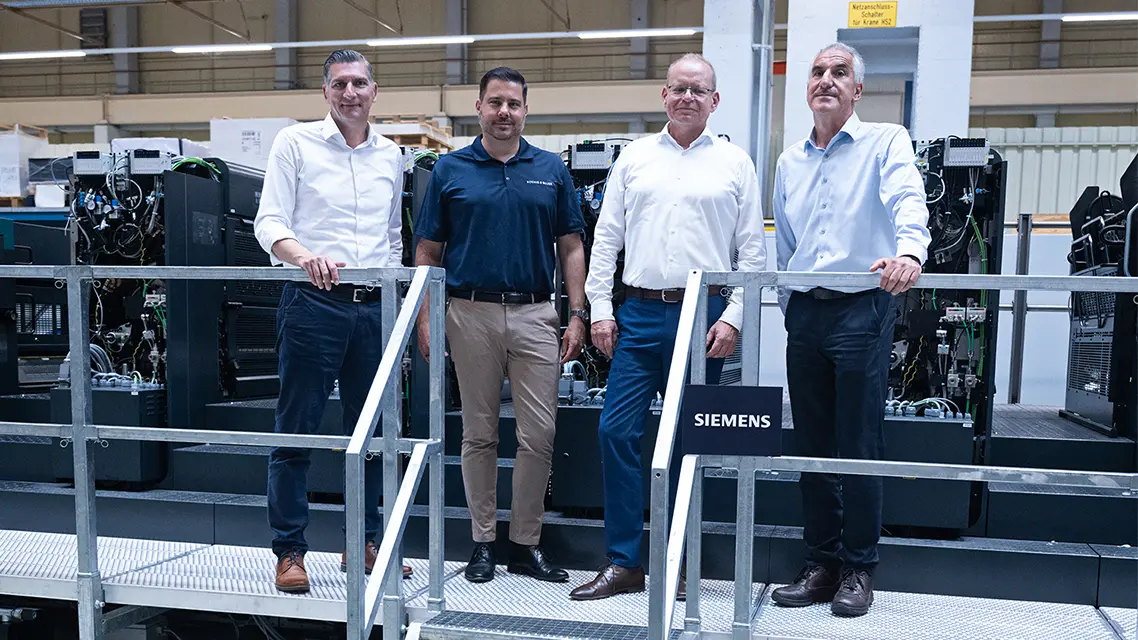
© Koenig & Bauer
The strategic partnership between Koenig & Bauer and Siemens, initiated one year ago, is progressing according to plan along the defined multi-year roadmap. In April 2025, the two companies announced their forward-looking collaboration in the field of developing sustainable machinery concepts.
The project is currently in the midst of an intensive, agile development phase. Rather than designing IT concepts in isolation at a desk, the teams from both companies are programming and evaluating the new architectures via close co-development directly on a Rapida 106 prototype. In this iterative process, they are developing step-by-step how essential core functions – such as absolute synchronicity in machine and sheet travel, washing programmes, or precise timing in the positioning programme – can be controlled in real time.
This approach to the further development of highly complex industrial installations for the global printing and packaging industry follows a clear logic: there is a demand for future-proof IT structures that fit seamlessly into modern factory ecosystems and offer maximum flexibility. At the same time, the global shortage of specialised automation experts requires new engineering approaches. Against this background, Koenig & Bauer and Siemens are pushing ahead with a long-term, strategic development project to create the foundations for future generations of printing presses. One year after the start of the project, this successful interim step demonstrates how a structured transition to a consistent, object-oriented IT infrastructure in high-performance mechanical engineering can be achieved.
Safeguarding the future through technological foresight
For Koenig & Bauer, this cooperation is an essential component of a forward-looking corporate strategy. Stephen Kimmich, CEO of Koenig & Bauer, puts the strategic horizon into context: “With our current product portfolio, our customers acquire installations that set the global benchmark for peak productivity and secure their competitiveness in the here and now. However, as industry pioneers, we bear the entrepreneurial responsibility to think further ahead. The strategic partnership with Siemens is the logical continuation of our technology strategy: we are breaking through existing system boundaries and making platform-independent software structures usable for the printing industry. In doing so, we are translating our current hardware excellence into the operational agility of the next decade.”
On the Siemens side, the project is also viewed as a pioneering partnership. Michael Thomas, Senior Vice President of Factory Automation at Siemens, explains: “Our collaboration is designed for a strategic, multi-year innovation path. In the demanding, high-end segment of mechanical engineering, modern IT tools and peak mechanical performance must mesh perfectly. This co-engineering allows us to thoroughly unlock the potential of our new control environment and, together with Koenig & Bauer, define tomorrow's standard.”
The technological core: SIMATIC AX and the project generator
The central objective of the project is the phased implementation of the ‘Advanced Machine Engineering’ concept. The high-level language-based platform SIMATIC AX is being used as the central development environment.
Christian Ziegenbalg, Chief Design Engineer at Koenig & Bauer, explains the strategic direction of software development for the printing presses: “In the course of this targeted modernisation, Koenig & Bauer is pursuing the clear goal of establishing a future-proof software structure using modern and standard-compliant programming languages. This forms the foundation for remaining competitive and high-performing in the coming decades. In doing so, we consistently orientate ourselves towards the proven flexibility in the sheetfed offset sector in order to be able to react agilely to market changes at any time.”
With the help of object-oriented programming and SIMATIC AX, complex machine functions are transferred into modular, hardware-independent software objects. These standardised components form the basis for both series production and custom-built systems, enabling the development of a scalable software library.
“The joint project with Siemens is an intensive and demanding development journey. It underlines our commitment to driving technological innovation through strategic cooperations,” explains Christian Steinmaßl, Member of the Group Management of Koenig & Bauer. The declared goal of both partners is to set new benchmarks in their respective industries, sustainably strengthen their market position, and guarantee customers long-term maximum stability and uncompromising quality.
The direct interplay of development and immediate verification on the machine serves the continuous, stable expansion of the software libraries. The technological added value of this new control level will be directly reflected in day-to-day production operations in the future. Deeper data integration will lay the foundation for seamless real-time monitoring and predictive maintenance (Predictive Maintenance via the myKyana service portal). Parallel to this, the future use of digital twins will enable virtual commissioning long before the physical manufacturing of the machinery begins. Furthermore, the open architecture forms the backbone for future-proof lifecycle management, including pre-certified safety libraries, as well as the option to flexibly activate digital machine functions as ‘Features on Demand’ via remote access in the future.
Heading for the industry milestone – drupa 2028
The project's roadmap follows a strict logic of operational reliability. Following the successful completion of the current development phases, comprehensive industrial trials in a real market environment will constitute future milestones prior to series release. For customers, this means absolute continuity: while the existing portfolio remains the established productivity benchmark worldwide, Koenig & Bauer and Siemens are setting the course for tomorrow. The partners will make the first concrete automation functions of this long-term development project tangible at the drupa 2028 industry trade fair.

Dagmar Ringel
Director Corporate Communications
+49 931 909 6756
Koenig & Bauer AG
Friedrich-Koenig-Straße 4
97080 Würzburg