English
 Deutsch

How We Raise Your Productivity to the Next Level
FOCUS ON PERFORMANCE
In the modern printing industry, downtime is more than just a technical issue – it is a disruption to the very heartbeat of the business. Our new performance approach demonstrates how vulnerabilities in the system can be purposefully transformed into highly efficient processes. A journey from fault diagnosis to unleashing one’s full potential.

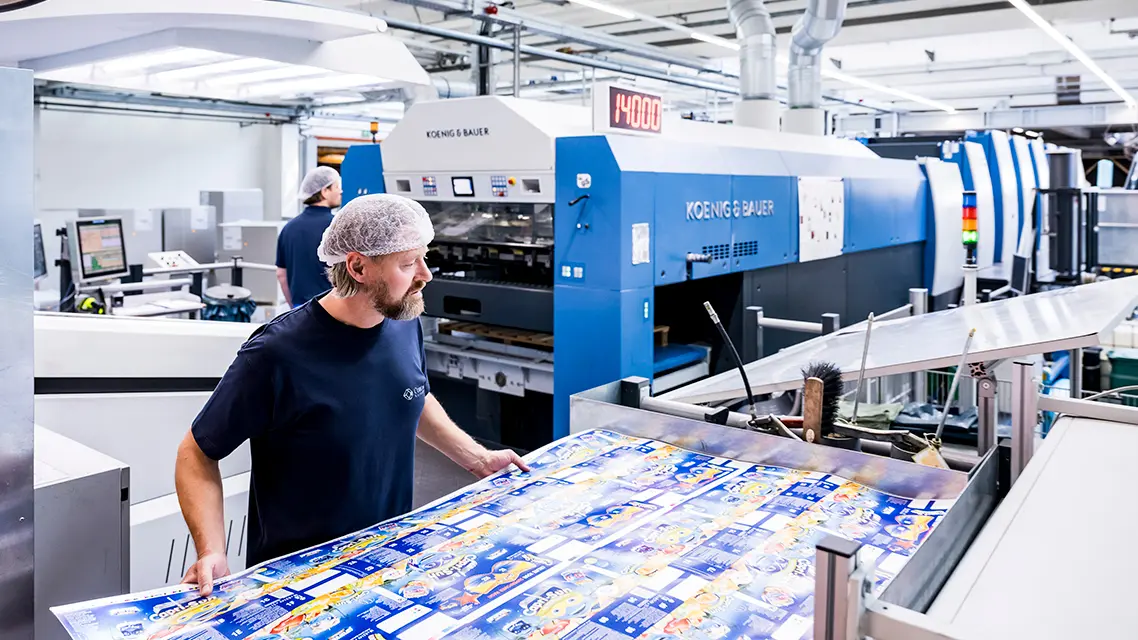
The printing industry is under intense pressure. Anyone wanting to remain competitive today cannot afford downtime – neither on the machine nor in the process. With the new Performance Service Products (PSP), we offer a modular system designed to tackle exactly this. At its core, it is about transparency and optimisation. Many customers know that their press is running well, but they have no idea that even greater net output is possible. Our PSP range is structured like a tiered system: from the single-day Quick Check PRINT and the four-day Process Analysis, through to the eight-day Improvement package.
Our Performance Modules at a Glance
| Duration | Your Benefit | |
|---|---|---|
Quick Check PRINT | 1 day | Fast status analysis without interrupting production |
Process Analysis | 4 days | Identification of potential, including detailed documentation |
Improvement Print Production | 8 days | Lasting increase in output, waste reduction & intensive training |
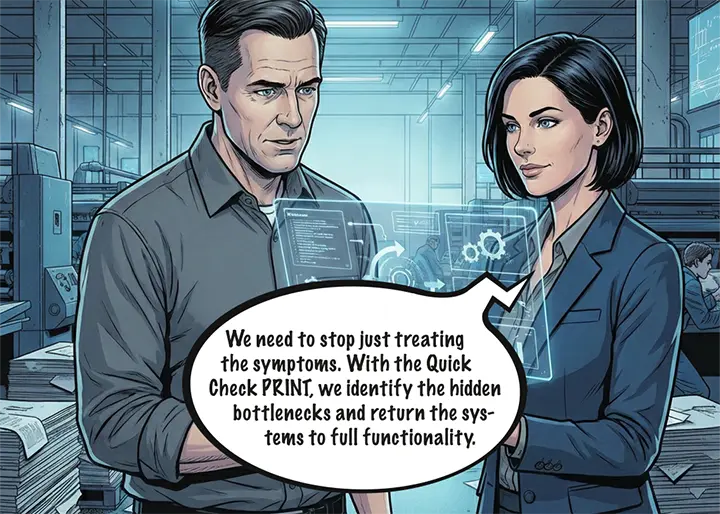
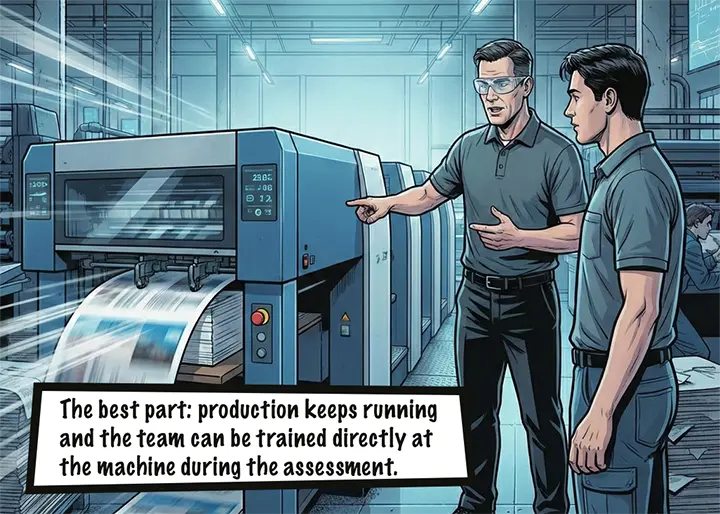
The best part right from the start: production keeps running! Thanks to the new digital tool (Quick Check PRINT app), we can systematically go through the printing process without any downtime. After one day, the customer receives initial brief feedback on the status of their printing press – including recommendations for safeguarding production and improving their machine's performance.
An example: despite having a modern Rapida 106, a packaging printer in Southern Germany was struggling with excessively long make-ready times and an excessive waste rate – so we started the Process Analysis. Using tools like myKyana, which provide data from the LogoTronic, we can see exactly where the bottlenecks are. In this case, for instance, it was not a technical issue, but rather down to the coordination of the measurement technology and internal workflows.
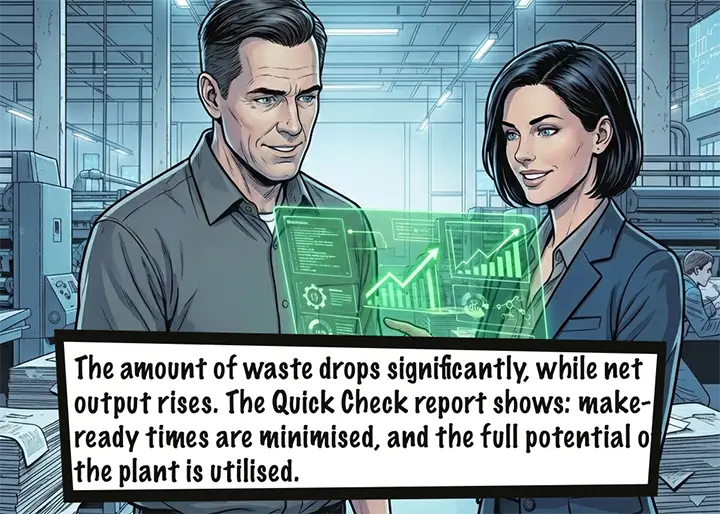
The solution: With the eight-day Improvement package, the employees were coached directly at the machine and the measurement technology was optimised. The result was impressive: net sheet output increased significantly, and waste was substantially reduced
The Rhythm of Precision
A Practical Look: How Coburger Kartonagen Is Setting New Performance Benchmarks
The long-established packaging company from Dörfles-Esbach has been in business for over 70 years. Following a major restructuring in the summer of 2025 and its subsequent integration into the Nordpack Group, it has undergone an unprecedented transformation. Managing Director Andreas Prahl’s clear goal: the highest possible efficiency. We illustrate how a six-year-old large-format Rapida 145 press was able to achieve exactly that, thanks to Performance Service Products (PSP).
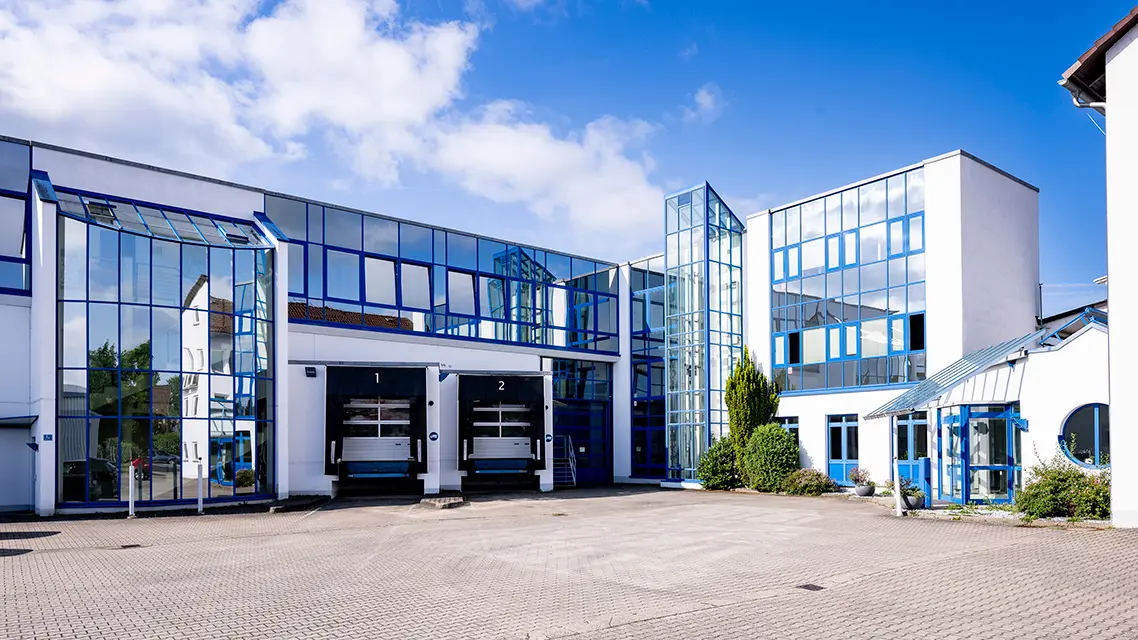
The fresh start: efficiency as the guiding principle
Following a turbulent economic phase and staff turnarounds, performance at the Coburg site had dropped noticeably. Although the plant possessed a highly modern, raised six-colour Rapida 145 press with a coater unit and delivery extension for packaging printing, its true potential lay largely untapped.
Immediately after the fresh start in September 2025, performance management was launched in cooperation with Koenig & Bauer. “We don’t chase ghosts, we uncover potential” – this credo of Michael Hallermann, Performance Consultant at Koenig & Bauer (DE), became the daily programme in Coburg.
The performance journey in three acts
The optimisation process was set up systematically and on a data-driven basis, with data from LogoTronic Professional playing a central role right from the start.
September 2025 – February 2026
09/2025
Optimisation of colour management and data utilisation via LogoTronic12/2025 – 02/2026
Intensive Speed-Workshop- Goal: Identifying weak points on the machine
- Method: Creating an exact 'make-ready script' together with the operators, taking precise time measurements, and staff training
February 2026 – May 2026
The game changers
In a second workshop, the team identified four decisive game changers:
- Installing new dampening rollers
- Targeted adjustments to the ink formulations
- Printing technology adjustments (special colours, setting aids)
- Improvement of print quality
From May 2026
Unlocking further potential
- Intensive evaluation of the available figures
- Identifying further potential for optimisation
- Continuous performance enhancement
The bare numbers: a first-class result
The sum of all optimised components – from maintenance and sheet inspection through to coaching – was phenomenally reflected in the performance data of the Rapida 145. The current status of the performance data is truly remarkable:
- Over 20 per cent improvement in the crucial KPI speed/performance.
- The average machine output over recent months stands at approx. 15,000 sheets/h. The share of machine output exceeding 16,000 sheets/h was raised from 0 per cent in June 2025 to over 40 per cent in April 2026.
- Production readiness is at an outstanding 96.8 to 98.8 per cent.
- Despite the drastically increased print output, the quality has improved significantly and ranks at an absolute top level.
The result in regional comparison: For three consecutive months – from February to April 2026 – the plant in Coburg was the highest-performing machine compared to similar presses across the entire DACH region. The subsequent months were only evaluated after the editorial deadline.
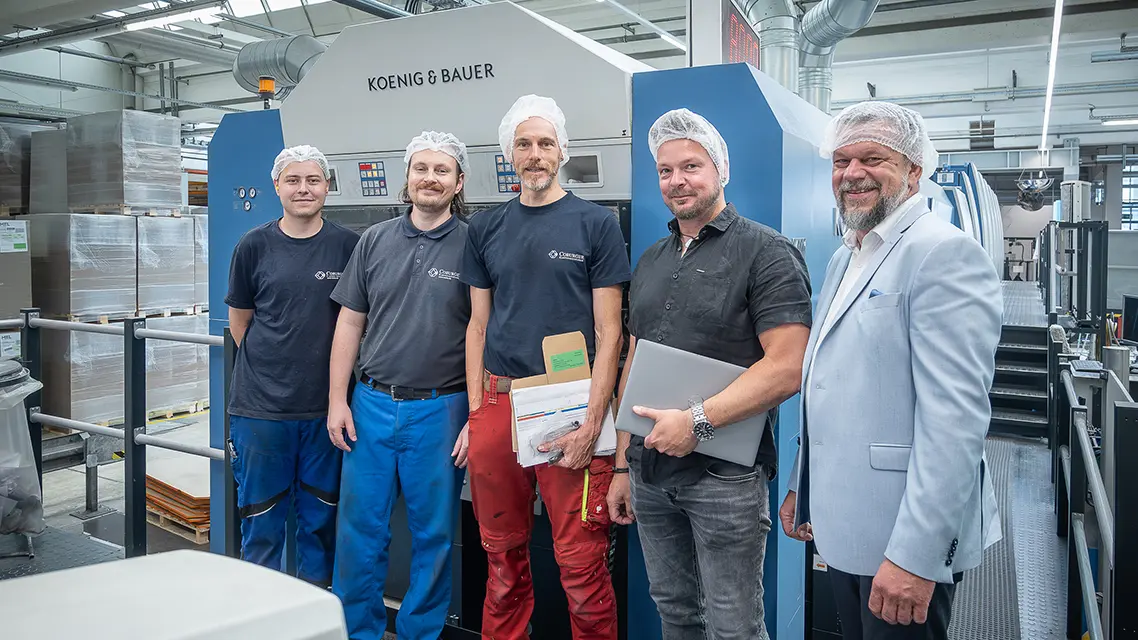
Among the top 5 worldwide
Michael Hallermann supports the project intensively and reports proudly: “I have rarely experienced a printing company where everyone involved has been committed so exceptionally well. Today, taking average gross production into account, this machine ranks among the top 5 worldwide.”
The enthusiasm is also tangible at Coburger Kartonagen, paired with a healthy dose of ambition. Michael Schmidt, Head of Process Optimisation and Lean Management, praises the newly gained, deeper understanding of the machine and its interdependencies: “We invest in our people and train our staff. The end point of the process has not yet been reached. At the moment, we have achieved about 70 to 80 per cent of what is possible.”
This aligns perfectly with the vision of Managing Director Andreas Prahl, for whom this success is merely an incentive for the future: “We are good, but where can we unlock even more potential? We are specifically looking for the details that can push us further ahead.”
The Coburg case shows impressively: for those who are willing to question existing processes, use data consistently, and coach the team at the machine, yesterday's limit is merely today's starting point.