 English
 Deutsch

The Age of the Autonomous Factory: Koenig & Bauer and RobCo Launch the Next Stage of Industrial Evolution With No-Code Robotics
Strategic partnership breaks down technological silos and delivers the answer to the global shortage of skilled workers as part of the strategic framework “IMPACT”
- Groundbreaking simplification: Highly complex, isolated work steps are translated into continuous, intuitive workflows through the use of innovative no-code technology
- Focus on postpress: Seamlessly closing manual interfaces from material feeding to palletising
- Central hub: The newly sharpened operational unit Factory & Machine Automation acts as a group-wide innovation driver for the flexible automation architecture
- Focus on people: The “Zero-Barrier-Automation” approach empowers the existing local staff to independently manage control without specialised IT knowledge
- Scaling & Time Horizon: The initial customer installation is scheduled for the first quarter of 2027
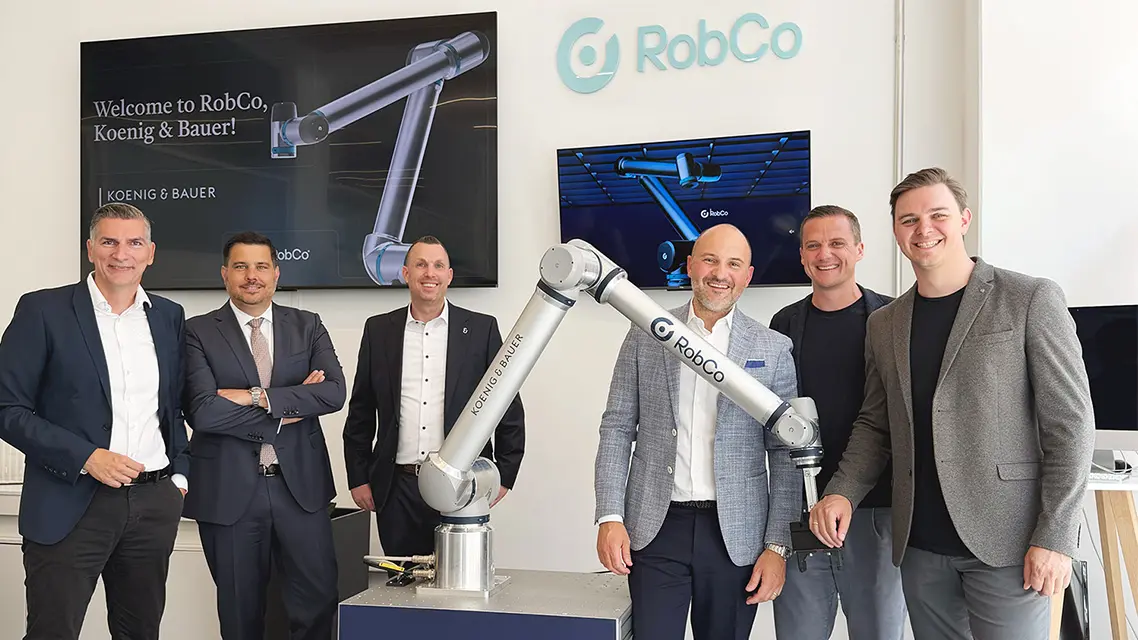
The starting gun has been fired for a new automation ecosystem: printing press manufacturer Koenig & Bauer is entering into a strategic partnership with the Munich-based robotics scale-up RobCo. The cooperation is part of the strategic framework “IMPACT” and aims to further advance automation in the printing and packaging industry.
At the heart of the collaboration is the optimisation of machine peripherals. Specifically, RobCo's robot systems are designed to automate those intermediate steps that arise between the actual printing process and the subsequent processing of the materials. By using no-code technology, where robots can be configured for new tasks without deep programming knowledge, these previously isolated work steps are to be integrated into seamless, digital workflows.
This partnership is the fundamental key element of an open, highly flexible automation ecosystem with which Koenig & Bauer is positioning itself as a general contractor for holistic, end-to-end production processes.
Strategic response to the shortage of skilled labor
With this step, the long-established Würzburg-based group is responding to the increasing structural change in the global manufacturing industry. In addition to noticeable pressure on margins, the industry is particularly struggling with a global shortage of skilled and unskilled workers. Hardly any company can afford efficiency losses at production interfaces anymore. Koenig & Bauer, whose technology portfolio sets benchmarks worldwide from the rapidly growing packaging market to classic commercial and industrial printing right through to highly complex banknote and security printing, delivers the answer to the industry's global challenges with this partnership and the targeted use of robotics solutions.
From machine builder to solution architect
"In times of volatile markets, our customers demand far more than just outstanding printing technology – they demand autonomy, fail-safe processes, and absolute resilience along the entire value chain," explains Dr Stephen Kimmich, CEO of Koenig & Bauer. "With our strategic framework 'IMPACT', we want to play a key role in shaping this requirement as a pioneer in the printing and packaging industry. The partnership with RobCo aims to break down technological silos and provide the market with scalable solutions in the future. Anyone who wants to remain competitive in modern production needs seamlessly interlocking overall systems and processes – fully orchestrated from a single source."
RobCo: Automation becomes a manageable standard
Until now, the greatest hurdle for manufacturing companies has rarely been the willingness to automate, but rather the complexity of the technical implementation. To break down this barrier, Koenig & Bauer relies on RobCo's approach. With a clear focus on software, the scale-up transfers the complexity of traditional robotics into modular plug-and-play architectures. As a result, robotics becomes a completely normal standard: automation becomes an easily manageable, natural tool for companies that can be flexibly integrated into the daily production process without expert knowledge. "Many automation projects do not fail because of the robotics itself, but because of its complexity. This is exactly where we come in. With our no-code platform, we enable companies to integrate and adapt robotics applications into their production processes much faster and more easily. Together with Koenig & Bauer, we combine deep industry knowledge with a flexible automation platform to make robotics accessible to significantly more companies and pave the way to more productive, resilient manufacturing processes," explains Roman Hölzl, CEO and Co-Founder of RobCo.
Factory & Machine Automation as a central automation hub
Koenig & Bauer has adapted its structure to translate the new technological approach into concrete added value for customers across the various business units. "True disruption requires combining the agility of a technology start-up with the scaling power of a global corporation," emphasises Christian Steinmaßl, member of Group Management. “This is precisely why we have deliberately established our Factory & Machine Automation unit as a group-wide automation hub. Equipped with a broad operational mandate and maximum entrepreneurial freedom of action, the Factory & Machine Automation team will orchestrate our open automation architecture in the future. RobCo is the ideal pioneering partner to translate this new ecosystem into economic added value for our customers in the printing industry right from the start.”
Zero-barrier-automation at the periphery
This central automation hub is headed by Markus Faude. As Vice President Factory & Machine Automation at Koenig & Bauer and one of the leading technological strategists for industrial automation, he directs his gaze exactly to where the greatest potential of modern production halls lies: on seamlessly closing manual interfaces along the entire processing chain. "The decisive potential for a leap in productivity lies not in the individual printing unit, but in the intelligent, continuous networking of the entire workflow," explains Markus Faude. "We are deliberately placing our strategic focus on the postpress sector. Regardless of the respective printing sector, the enormous performance of modern production facilities is limited exactly here – in further processing – by manual intermediate steps. The aim of our partnership is to close these gaps through smartly orchestrated robotics applications – from automated material feeding to final palletising." Through targeted co-development with key customers, the Factory & Machine Automation unit merges domain application knowledge with RobCo's plug-and-play robotics.
For Faude, intuitive operation and rapid adaptability are the central levers in the context of the skilled labor shortage: "With our 'zero-barrier-automation' approach, we place the human at the center of the smart factory. The technology is subordinate to the user, not the other way around," Faude sums it up. “Through the symbiosis of no-code software and our OEM system expertise, we empower local employees to independently control automated processes after a very short time and flexibly reconfigure them for new requirements. This breaks the dependence on highly specialised IT resources, relieves teams from day one, and closes the gap to the autonomous overall process – from the unprinted substrate to the goods ready for dispatch. Together with our customers, we are making the 'Autonomous Print Shop' a reality.”

Dagmar Ringel
Director Corporate Communications
+49 931 909 6756
Koenig & Bauer AG
Friedrich-Koenig-Straße 4
97080 Würzburg